Guru: The One Who Awakens the God Within
This blog explores the timeless role of the Guru and their importance in the modern world. Drawing from Indian spiritual tradition, saints, and disciples, it explains how a true Guru removes ignorance, awakens inner awareness, and guides the spiritual seeker toward dharma and liberation. Through well-known stories of transformation, the blog highlights the Guru’s power to reshape character and redirect life toward truth, showing why Guru kripa (grace) is considered the foundation of spiritual growth. This guide is for anyone seeking direction and a deeper understanding of true spiritual mentorship.
9 min read
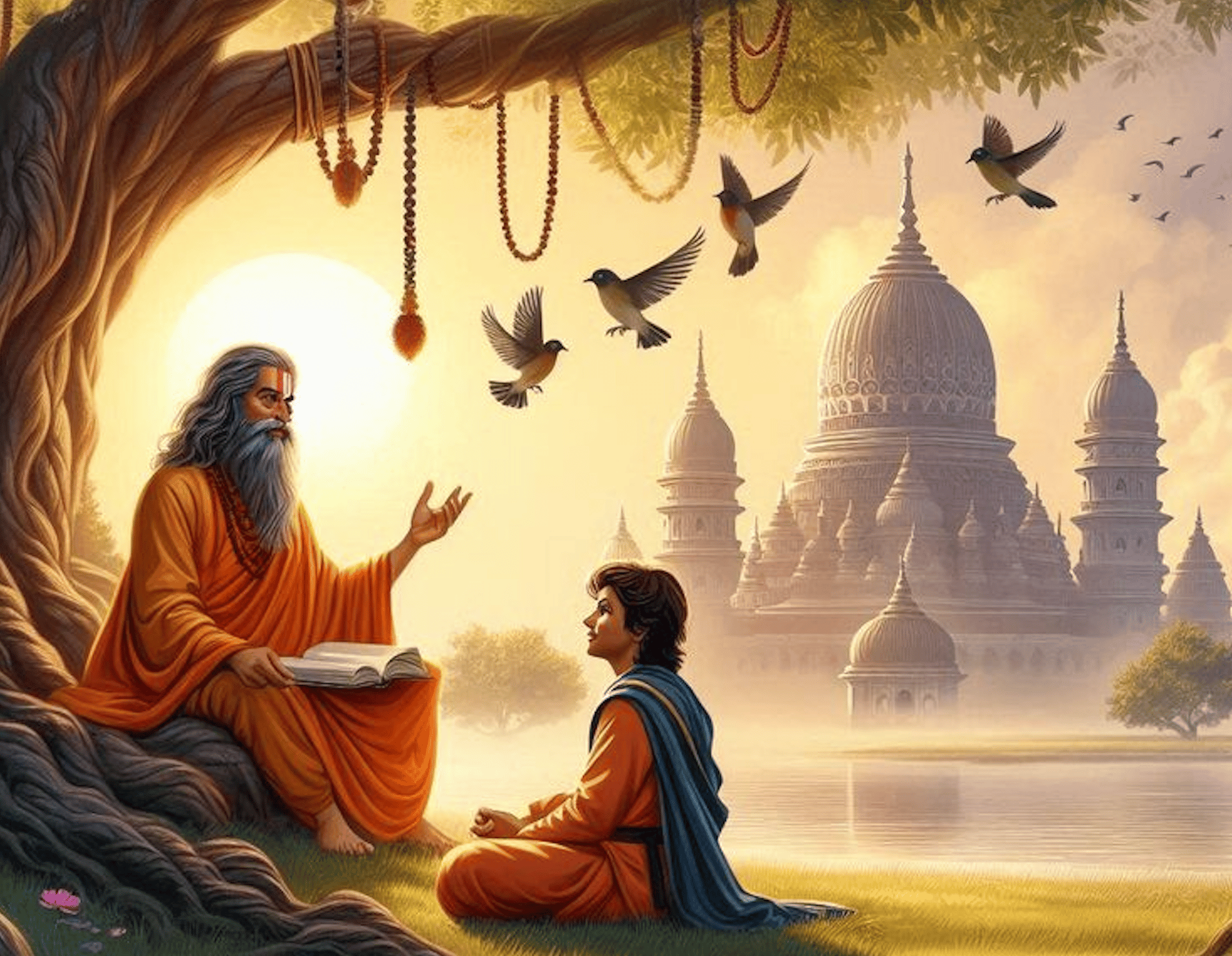

The Role and Importance of the Guru
The word Guru comes from two Sanskrit syllables: Gu, meaning darkness, and Ru, meaning remover. A Guru is not just a teacher or mentor, but a remover of ignorance—a guide who leads us from darkness to light. In today’s world, filled with distractions and sensual pleasures, the need for a Guru cannot be overstated. A mentor may help us with worldly matters such as career, goals, or personal development, but a Guru works at a much deeper level. A true Guru touches the soul, helping us rise above sorrow, confusion, and ignorance, and guiding us closer to our true nature—Aham Brahmasmi (the Divine Self).
A Guru helps us rise above the six Avagun (weaknesses) of human nature. These begin to fade naturally in the presence of a Guru:
Kaam (lust), Krodh (anger), Lobh (greed), Moh (attachment), Mad (pride), and Matsar (jealousy).
A Guru is not just a wise human being—they are a living embodiment of the Divine. We often fail to recognise them because of our limited understanding, but in reality, they carry the light of God in human form.
Even divine beings had Gurus; they reminds us how crucial it is to have a Guru in life.
Lord Krishna learned under Sandipani Rishi.
Lord Ram was guided by Sage Vashisth and Vishwamitra.
Now, the question is: whom should we consider a Guru?
Saint Tulsidas beautifully wrote in the Ramcharitmanas that a true Guru is someone whose very presence begins to transform your habits, speech, and thoughts. If just seeing someone stills your mind, and if you feel drawn to their words again and again — that’s the sign of a real Guru.
Transformative Power of Guru
Let me share a few powerful and real stories from Indian tradition. They show just how deeply a Guru can transform someone’s life.
Valmiki and Narad Muni
Valmiki was once a feared bandit named Ratnakar. He robbed and killed people to feed and care for his family. One day, while Narad Muni was crossing the forest, Ratnakar tried to rob him. Narad Muni had nothing but his veena, yet he calmly asked a question that shook Ratnakar to his core:
“Will your family take a share of your sins?”
Ratnakar laughed at first, but to confirm he went home and asked his parents, wife, and children. To his shock, they all said no. They enjoyed the comforts he provided, but none were willing to share the burden of his sins. This broke his heart. Hurt and shaken, he returned to Narad Muni and asked for guidance. Narad Muni told him to chant and meditate upon the name of Lord Ram. Ratnakar began meditating with deep remorse. He stayed so still that ants built a hill over his body. Through years of penance and devotion, he was transformed. He became Sage Valmiki—the great poet who wrote the Ramayan. This teaches us that even the most sinful soul can be transformed by a Guru's guidance.Prahlad and Narad Muni
Prahlad was the son of the demon king Hiranyakashyap, who hated Lord Vishnu and wanted everyone to worship him instead. But even before Prahlad was born, his mother had spent time with Narad Muni and listened to his teachings. Those words of wisdom went deep and reached Prahlad in the womb!As he grew, Prahlad became a fearless devotee of Lord Vishnu. This enraged his father. Hiranyakashyap tried everything to break his son’s faith—from persuasion to punishments, even attempts to kill him. But Prahlad remained calm and devoted, chanting Lord Vishnu’s name without fear. His Guru's influence had planted a devotion so deep that even death couldn't harm him. This teaches us that it's essential for both parents to engage in spirituality before conception and throughout pregnancy.
Swami Vivekanand and Sri Ramakrishna
Narendra was a brilliant and curious young man who questioned the existence of God. One day, he met Sri Ramakrishna, a saint who became his Guru and transformed his life. Instead of simply debating, Ramakrishna smiled and said, “Don’t believe me blindly. Experience it yourself.” Then, with just one divine touch, Ramakrishna gave Narendra a deep spiritual vision. It was something beyond words—something no logic could explain. That one moment changed him forever.Totakacharya and Adi Shankaracharya
Giri was a humble and quiet disciple among many brilliant scholars learning under Adi Shankaracharya. Most people thought he wasn’t very intelligent, but Giri had one quality that truly stood out—his deep devotion and selfless service to his Guru. He would engage himself in Guruseva so much that he often forgot his own needs.
One day, as Shankaracharya was about to begin teaching the Vedanta Upanishads, the other students suggested starting without Giri, assuming he wouldn’t be able to understand. When Shankaracharya heard this, he became upset. Seeing Giri’s pure heart and unwavering devotion, he chose to bless him by sharing a part of his divine knowledge.
To everyone’s amazement, Giri came and started singing beautiful Sanskrit verses in praise of his Guru—these became the famous Totakashtakam. From that day, he was no longer just Giri. He became Totakacharya, one of Adi Shankaracharya’s foremost disciples. This shows us that sincere Guruseva (service to the Guru) can open the door to knowledge, wisdom, and liberation. That’s why scholars say, "मोक्शमूलं गुरु कृपा" — liberation begins with the grace of the Guru.Jesal and Toral
Jesal was once a feared bandit in Gujarat who looted villages and had no regard for dharma. One day, he encountered Toral, a saintly woman filled with divinity. When he approached her, she didn’t resist him with fear. Instead, her quiet fearlessness and purity pierced through Jesal’s heart. Something about her presence melted him. He surrendered—not to her, but to the divine reflected in her. He became her disciple, gave up violence, and lived the rest of his life in devotion.
Parshuram and Rishi Kashyap
Parshuram, known for his anger and immense power, had destroyed many warrior clans in revenge for his father’s murder. His axe had tasted too much blood. Kings, terrified by the unstoppable destruction caused by Parshuram, approached his Guru, Rishi Kashyap to seek help. They begged him to intervene and stop the massacre. Moved by their plea, Rishi Kashyap agreed and went to meet Parshuram.
Parshuram was about to set out for the 22nd time to destroy the Kshatriya clans, but the moment he heard the word “Ram” from his Guru, his anger dissolved. He ran to his Guru and fell at his feet. Rishi Kashyap looked at him and said, “Enough Ram, now leave your weapons.” Without a word or hesitation, Parshuram obeyed. He surrendered and walked away from the path of bloodshed. This shows that a Guru’s words can truly melt a disciple’s heart.
Arunagirinathar and Lord Kartikeya
Arunagirinathar was once a man of worldly pleasures. Born in Tamil Nadu, he spent his youth indulging in sensual desires. His family gave up on him. Eventually, ravaged by disease and shame, he climbed the temple tower at Tiruvannamalai—ready to end his life. He jumped, but something miraculous happened - Lord Kartikeya caught him mid-fall and gave him a new life. He healed Arunagirinathar’s body, and filled his heart with Bhakti (Devotion).
From that day, Arunagirinathar became a saint-poet. He travelled and sang soul-stirring hymns in praise of Kartikeya—verses that still echo in temples today. This shows how the Divine can appear to transform life, even in the darkest moments.
There are countless examples where a Guru has transformed the life path of their disciples. Some other notable ones include Bilvamangal and Chintamani, Rishi Vishwamitra and Vashistha, Matsyendranath and Gorakhnath, Shvetaketu and Uddalak, Dhandhukari and Gokarna, Ajamil and the saints, Jagai–Madhai and Chaitanya Mahaprabhu, and many more. However, to keep this blog concise, I have highlighted only a few.
Disciples’ Love for their Gurus
Throughout Indian spiritual history, some of the greatest minds, poets and spiritual seekers didn’t just revere their Gurus — they composed timeless hymns and philosophies dedicated to them.
Adi Shankaracharya
One of the greatest philosophers in Indian history, he established Advaita Vedanta and traveled across India, debating and unifying various schools of thought. Despite his immense brilliance, he bowed deeply to his Guru, Govind Bhagavatpad, and composed two powerful hymns: Guru Ashtakam and Guru Paduka Stotram.
Swami Vivekanand
Swami Vivekanand, also known for extraordinary intelligence, introduce Indian spirituality to the West, was deeply shaped by Sri Ramakrishna. He once said, “If I have told you one word of truth, it is all by the grace of my Guru”
Kabir Das
A mystic poet whose verses shaped the Bhakti movement, Kabir often wrote about his Guru Ramananda. His poetry carries piercing lines like:
“Guru Govind dono khade, kaake laagu paay?
Guru ki kripa Govind mile, Govind ki kripa na hoy.”
(If both Guru and God stand before me, whose feet should I touch first? I choose my Guru, because it is through him that I found God.)Tulsidas
Tulsidas, the author of Ramcharitmanas, saw Lord Hanuman as his Guru. His entire literary and devotional life was shaped by the blessings and visions given to him by Hanuman, whom he revered as the one who opened his heart to Lord Ram. Inspired by this devotion, he composed the Hanuman Chalisa and Bajrang Baan, hymns that continue to uplift countless spiritual seekers.
There are countless examples of disciples expressing the love and grace of their Guru, but to keep this blog concise - I have shared only a few here.
The Power of Surrender
Many often mistake surrender as blind obedience. but that’s not true. Real surrender isn’t easy. It means letting go of sensual pleasures and having control over all five senses and mind. True surrender means living according to the guidance of the Guru and the scriptures.
The ego resists surrender, and it’s not just from this life. According to the scriptures, our ego lives in the sukshma sharir (subtle body), which carries impressions (sanskars) from many lifetimes. That’s why even the poorest or most uneducated person can still be full of pride when challenged.
But when we surrender to a Guru or God, grace flows in. In Bhagavad Gita Chapter 12, Verse 8; Krishna says:
मय्येव मन आधत्स्व मयि बुद्धिं निवेशय। निवसिष्यसि मय्येव अत ऊर्ध्वं न संशयः
Keep your mind on Me alone, place your intellect in Me. Then, without doubt, you shall live in Me forever.
In Chapter 12 (Bhakti Yog), Krishna repeatedly says: Surrender unto Me alone — I will not only rescue you from the ocean of birth and death, but I will also provide what you lack and preserve what you have.
Why the Need for a Guru Is Greater Than Ever Today
A true Guru helps us when we feel anxious, uncertain, or directionless in life. Real change in life does not come from our efforts alone, but through the grace of the Guru or God. Saints have always said this, and the examples shared earlier clearly show how the life trajectory of many changed suddenly simply because of their Guru. A Guru also helps us establish Niyam (disciplines)—simple daily practices to follow and certain things to avoid, no matter what. These timeless principles, passed down by the sages, are guiding the individual toward a dharmic life. Without proper guidance from a Guru, Maya can easily drift us away from the right path. Our aim is to remain consistent in Abhyas (practice) as taught by the Guru, just as Lord Krishna advised Arjun in the Bhagwad Gita.
Have you ever noticed that, despite knowing what is dharmic (right) and adharmic (wrong), we often end up choosing the adharmic path? This happens because of our environment. The environment we live in can either lead us toward liberation or trap us in regret and sorrow.
That is why Acharya Vishnugupt in Niti Shastra said:
श्वपचैः सह वने वासो वरं स्वर्गेऽपि अधार्मिकैः सह न वासः।"
It is better to dwell in the forest with animals than to live in heaven with the unrighteous (adharmic).
Here are a few examples from history that show what happens when we choose the right path versus the wrong one:
Karna, despite his generosity, met a tragic end because of his loyalty to Duryodhan.
Yuyutsu, though born in the Kaurav camp, chose to side with the Pandavas when the war began. He stood for dharma over family, and because of that, he survived the war and was later entrusted with the responsibility of ruling the kingdom when Pandavas retired.
Kumbhakarn, though wise and devoted in many ways, stood by his brother Ravan and faced destruction.
Vibhishan, on the other hand, chose dharma over blood ties and was ultimately rewarded with a kingdom and immortality.
The message is clear: our thoughts and the people around us shape our future. Even the wise can fall when walking with the wrong crowd. But those who choose the right path, even when it’s hard, are the ones who find unending joy, respect and opulence.
According to the teachings of scriptures and saints shared in satsang, the strength to walk the right path comes through:
Surrender (aligning thought, speech and action with scriptures and Guru)
Tapasya (disciplined practice like meditation, mantra, naam jaap)
Swadhyay (self-study and reflection)
But if we surrender our mind, body, and intellect fully at the feet of a Guru, then: "Guru Kripa Hi Kevalam" — the Guru’s grace alone is enough. Living according to the knowledge and wisdom shared by the Guru is the true Guru Dakshina. No amount of money or gifts can equal that.
To end, I want to share two lines for my Guru, whose presence has had a transformative impact on my life. This verse from the Kritagyata Stotram 11 captures what my heart feels:
कृतज्ञता या च हृदि स्थिता मे वक्तुं न शक्या खलु यत्नतोऽपि ।
गुरो प्रसीद कृपया विधेहि त्वत्पाद-भक्तिं परमानुरक्तिम् ॥
The gratitude I feel in my heart, I can’t explain or describe, even if I try. O Guru, please be gracious and bless me with devotion to your lotus feet.