The Four Paths to Moksh in Hindu Philosophy
Discover the four spiritual paths in Hindu philosophy—Bhakti, Gyan, Karma, and Raj Yog—which guide seekers toward liberation (moksh) and union with the divine.
4 min read
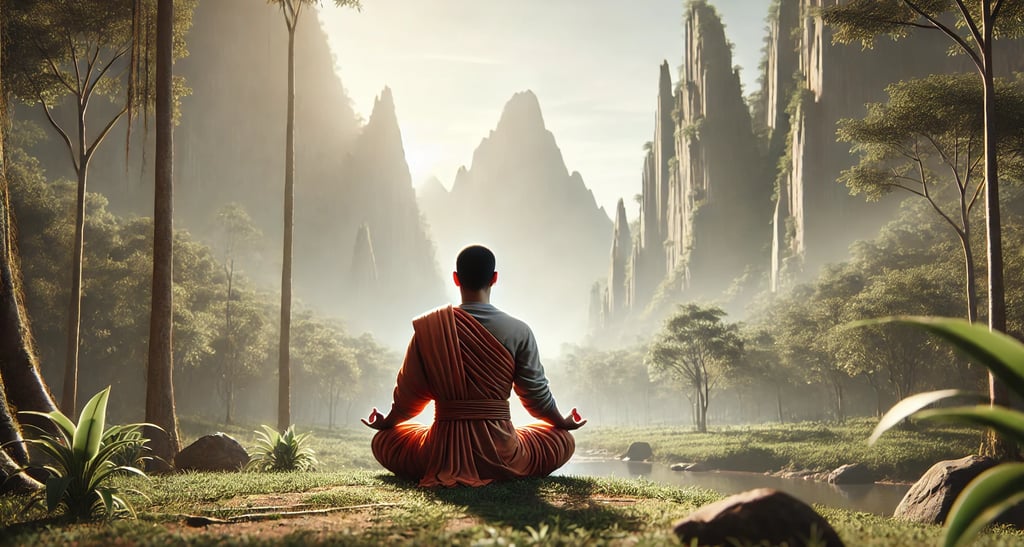

Moksh or liberation, is the ultimate goal in Hindu philosophy. It represents freedom from the cycle of birth and death (sansar) and the union of the individual soul (atma) with the universal consciousness (Paramatma or Brahma). Hinduism prescribes four main paths to achieve libration, each catering to different temperaments and inclinations of individuals. These paths are Bhakti Yog, Gyan Yog, Karma Yog, and Raj/Dhyan Yog. Before we dive into each of those, let's first understand the importance of Guru and Brahmacharya.
The Role of Brahmacharya in Attaining Moksh
Brahmacharya, in modern times, is often understood as self-restraint or celibacy only, but it encompasses much more. At its core, it's about continuously thinking about our true self (Brahma). It is considered as an essential discipline across all four paths to moksh. It involves controlling and diverting our physical and mental energies to focus entirely on spiritual growth. Brahmacharya provides innumerable benefits and helps us remain disciplined in our path, enabling us to progress steadily on spiritual journey and create the ideal conditions for self-realisation.
For those who are married, the shastras (spiritual texts) advise practicing restraint and engaging in physical union only for procreation or when the urges become uncontrollable. This balanced approach supports the spiritual path by minimising distractions and preserving vital energies, which are essential for spiritual growth. Now, let’s dive deeper into each Marg (Path).
The Importance of the Guru
Across all four paths to moksh, the guidance of a Guru is regarded as essential in Hindu philosophy. While each path differs in practice and temperament, scriptures—as well as divine figures such as Lord Ram and Lord Krishna—have emphasised that liberation cannot be attained through individual effort alone. Hindu tradition consistently highlights the central role of the Guru–disciple relationship, as seen in the following prominent examples:
Adi Shankaracharya → Govind Bhagavatpad
Prahlad and Dhruv → Narad Muni
Nachiketa → Yam (Katho Upanishad)
Svetaketu → Aruni Uddalaka
Swami Vivekanand → Sri Ramakrishna
Swami Sivananda → Swami Vishvanand Saraswati
Paramhans Yogananda → Sri Yukteswar
A Guru helps awaken true devotion, dispels ignorance, prevents ego-driven misunderstanding, and provides wisdom and strength where knowledge or personal discipline may fall short. Thus, while the paths to moksh may vary, the presence of a Guru remains a unifying and indispensable principle in the journey toward liberation.
1. Bhakti Yog: The Path of Devotion
Bhakti Yog emphasises love and devotion towards a personal deity. It's considered as one of the easiest of the four paths. Hindu scriptures encourage forming a deep, exclusive bond with one chosen deity—be it Krishna, Ram, Shiv, Mahakali, or another form of the divine. This singular focus strengthens emotional connection and deepens spiritual practice. This path involves surrendering oneself entirely to that deity, cultivating an emotional bond, and expressing devotion through various means.
Core Practices: Chanting mantras, naam jaap, singing hymns (bhajans), and participating in religious ceremonies (satsang).
Who It Appeals To: Those with a naturally emotional and devotional disposition.
Key Teachings: By surrendering the ego and fostering unconditional love, one can merge with the divine.
Prominent Example: Mirabai and Narsinh Mehta, saint-poets devoted to Lord Krishna, are well-known figures who exemplify Bhakti Yog. Their unwavering love and devotion for Krishna led them to spiritual enlightenment.
2. Gyan Yog: The Path of Knowledge
Gyan Yog is the intellectual path to moksh, focusing on self-inquiry and deep philosophical understanding. It requires the seeker to discern between the eternal and the transient and to realise the unity of the self with Brahman. This path is extremely challenging and can only be followed by a few. After realisation, one might develop ego due to extensive knowledge of the self and the universe. Therefore, the scriptures strongly advise seekers to follow a guru and remain humble.
Core Practices: Studying scriptures such as the Vedas and Upanishads, practicing self-inquiry (Atma Vichar), and meditating on the nature of the self.
Who It Appeals To: Philosophical minds inclined towards analysis and reasoning.
Key Teachings: Ignorance (avidya) is the root of bondage, and knowledge (gyan) is the path to liberation.
Prominent Example: Adi Shankaracharya, a revered philosopher and theologian, is a prime example of Gyan Yog. His teachings and commentaries on Advait Vedant emphasised self-realisation through knowledge.
3. Karma Yog: The Path of Selfless Action
Karma Yog teaches the importance of performing one’s duties selflessly, without attachment to the results. It promotes the idea that dedicating all actions to the divine purifies not only the mind and karmic activities but also leads to liberation.
Core Practices: Engaging in selfless service (seva) especially towards a Guru and parents, fulfilling one’s duties with integrity, and relinquishing the fruits of one's actions.
Who It Appeals To: Active individuals who find purpose in work and service.
Key Teachings: By acting without desire or selfishness, one transcends the ego and aligns with the divine will.
Prominent Example: King Janak is often cited as an ideal figure in the path of Karma Yog. Despite being a ruler and engaged in worldly duties, he was known for his selfless actions and detached from the results of his work. His story shows that one can lead a life of action, responsibility, and leadership while remaining spiritually detached and focused on the ultimate goal of moksh.
4. Raj Yog: The Path of Meditation
Raj Yog is the systematic practice of meditation and self-discipline aimed at spiritual realisation. It involves mastering the mind and body to attain inner stillness and union with the Divine. This path is also demanding and requires sustained discipline, patience, and tolerance, as outlined in the principles of Ashtang Yog.
Core Practices: Yam, Niyam, Asan, Pranayam, Pratyahar, Dharna, Dhyan and Samadhi.
Who It Appeals To: Those with a disciplined and contemplative nature.
Key Teachings: Through complete control of the mind and senses, one can achieve a state of pure consciousness and liberation.
Prominent Examples: Swami Vivekanand, Swami Sivananda, Ramana Maharshi, and Paramhans Yoganand are some examples of people who followed this path.
Conclusion
These four Marg (paths) allow individuals to choose an approach that resonates with their nature and temperament. Although these paths may appear distinct, they are unified by the indispensable presence of the Guru and are often interconnected, with many seekers integrating elements from each in their spiritual journey. Ultimately, the purpose of moksh lies in aligning the self (Atma) with the eternal truth (Brahman).