What We Can Learn from Arjun
This blog explores the powerful life lessons and values we can learn from Arjun—like devotion, discipline, focus, perseverance, and the ability to turn challenges into opportunities. Lesson are drawn from Arjun’s journey and Krishna’s teachings. Now more than ever, we need such teachings and guidance from our history to help us walk the path of life with qualities Arjun embodied.
9 min read
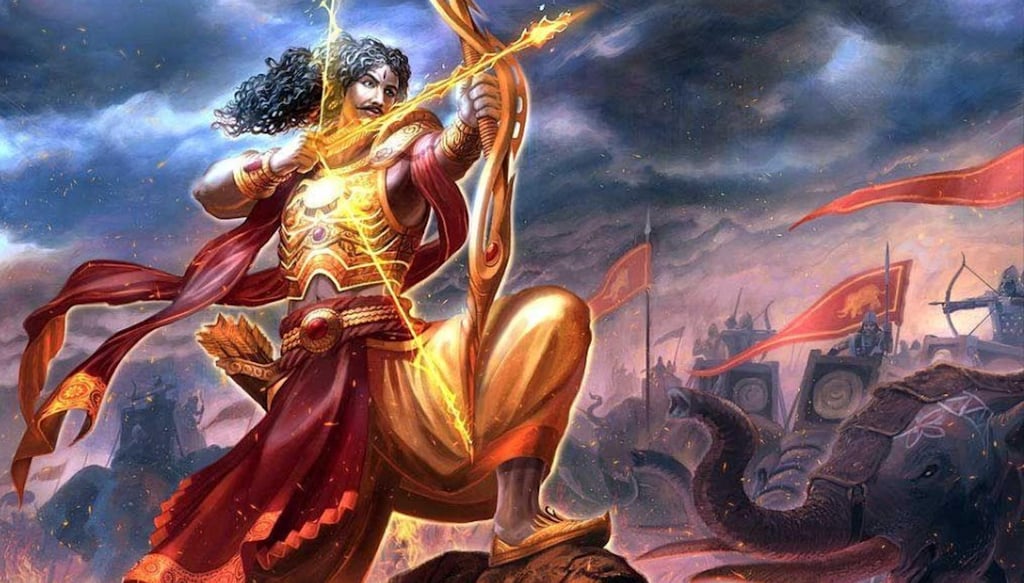
In the modern world, due to the influence of friends and our surroundings, many of us have forgotten what it means to live by Dharma. Qualities like संस्कार (moral conduct or values), ध्येयनिष्ठ (goal-oriented) आत्मविश्वास (self-confidence), निर्भयता (fearlessness), तेजस्विता (radiance or willpower), तपस्विता (austerity and discipline), and तत्परता (dedication) seem to be fading away. These were the very traits our ancestors lived by, which is why Indian culture was once known for its richness and depth. But can we say the same about our culture today? Today, many of us are living life without emotions (भावशून्य) — and without inner radiance (निस्तेजता).This is because Dharma is missing from our lives.
Our scriptures say:
"Yuva Syat Sadhu Yuvadhyayaka: Aashita, Dradhishta, Balistha." — A young person should be virtuous, disciplined, determined, and strong.”
Now ask yourself — do we see this kind of youth in today’s society? Honestly, not really. These are the very qualities Arjun had. Beyond his skills, it was his character, commitment, and fearlessness that made him truly great. With the right mindset, action, and guidance from a Guru, we too can bring these qualities into our lives. Let’s take a look at the qualities and abilities that made Arjun who he was and how we can bring them into our own lives.
1. Bhakti
Despite being one of the greatest warriors (Maharathi), Arjun remained humble and deeply devoted to Krishna. This is one of the first qualities we can learn from him. Now think about Hanuman. He was never defeated, not just because of his strength alone. There were many powerful kings and demons like Hiranyaksha and Hiranyakashipu. Even Lord Vishnu had to take special avatars—Varaha and Narasimha, to defeat them. Then there was Sahastrarjun (also known as Kartavirya Arjun), whom Vishnu had to confront as Parshuram. Meghnath (also known as Indrajit), was so powerful that even Lakshman, an avatar of Sheshnag (the serpent on whom Vishnu rests), had to perform 12 years of Tapasya to defeat him. Vritrasur, for whom Rishi Dadhichi gave up his life so Indra and other Devtas (Demi-gods) could make the Divine weapon Vajra. Demons like Mahishasur and Raktabeej, whose strength grew so immense that even the gods had to call upon the Divine Mother to destroy them.
All these beings possessed immense power, but they lacked one thing, something both Arjun and Hanuman had. That was Bhakti: love, devotion and complete surrender to God. Bhakti and surrender are not signs of weakness, but true strength, something we can all learn from Arjun and Hanuman.
The turning point in Arjun’s life was when he surrendered in front of Krishna. In Bhagvad Gita 2.7, he says:
शिष्यस्तेऽहं शाधि मां त्वां प्रपन्नम् - I am Your disciple, surrendered to You. Please instruct me.
That one moment of surrender changed everything not just for Arjun, but for all of humanity. From that point on, Krishna began sharing the wisdom of the Gita. When guided by a Guru like Krishna, what remains to be understood or done? The path becomes clear, and the strength to accomplish any task naturally develops. Many of us stand at a similar fork in life. We get anxious about our future, about our family, our personal life, our career. But what we often lack is Bhakti. If we truly develop this one quality, God Himself takes responsibility for our life, as Krishna says in the Bhagwad Gita.
Think about it — Bhishma, under pressure from Duryodhan, took a vow to kill Arjun. Krishna, even after promising not to lift a weapon in the war, picked up a chariot wheel just to protect him. When Bhagadatta launched the Vaishnavastra, Krishna stood in front of Arjun and took the attack upon Himself. There are many such moments in the Mahabharat. When Draupadi was being disrobed, Krishna was the one who came to her rescue. During the Pandavas’ exile, when Rishi Durvasa visited them, Krishna saved them from his anger and possible curse. He also helped them turn Khandavprasth (a barren land), into the magnificent city of Indraprasth. All these events tell us one thing, that when we truly surrender He takes care of everything. Look at the lives of His devotees and you’ll see the same truth: He protects and nurtures them like a mother cares for her child.
If you want to understand what it really means to be a devotee and how to become dear to Krishna, you can read my blog — Bhakti Yog: The Path to Vaikunth. I have shared thoughts from the Bhagwad Gita (Chapter 12), the Shrimad Bhagvat Mahapuran, and knowledge I have received from my Guru, all explained in a simple way. It talks about love, surrender, and the qualities that help us grow closer to God.
People often admire Arjun’s strength, but few speak about his heart. After Krishna left His body, Arjun was shattered. For the first time, he failed to protect the people of Dwarka from the forest tribes (Bheels). Even during the war, when Abhimanyu was killed or when he had to fight Bhishma, Arjun remained strong. But after Krishna’s departure, he completely broke down. The Shrimad Bhagvat says that Arjun could not even stand properly before Yudhishthir to explain what had happened in Dwarka. That grief, that deep longing, was the bhav (emotion) of a true devotee.
2. The Importance of a Clear Goal (Lakshya)
One of the most astonishing moment that shows Arjun’s single-minded focus is when he rejected Urvashi, the most beautiful apsara of Indralok. When she approached him with desire, Arjun folded his hands and respectfully addressed her as a mother. He said, “You are the consort of my ancestors; I see you as a mother figure. Please forgive me.” Urvashi cursed him to lose his manhood, but even that became a blessing later during his role as Brihannala in exile. This shows us one thing: if you have Krishna’s grace with you, moments of failure and sadness will eventually turn into success and bliss. This wasn’t just about celibacy, it was about choosing purpose over pleasure. Arjun was sent to the heaven to gain divine weapons, not to indulge in heavenly distractions. He stayed true to his mission, and this is yet another characteristic we can learn from him.
In life, we often drift without a clear purpose or end goal. Wandering mind cannot build anything lasting. Like Arjun, we must ask ourselves: What am I aiming for? Without lakshya, tapasya can become directionless, and even strength can go unused. Whatever your goal is, once purpose is fixed in your heart and mind, every quality you develop starts working in alignment. Tapasya gives it power and aabhyas sharpens it.
3. Aabhyas and Niyam – Practice and Consistency
Arjun was Dronacharya’s favourite disciple because of his dedication. One night, Arjun saw Bheem eating in the dark. Even without seeing the food, Bheem’s hand effortlessly found his mouth. Arjun thought, “If Bheem can do this without light, why can’t I practise archery at night?” From that day, he trained in the dark, sharpening his focus and reflexes.
It’s this kind of aabhyas (practice) and niyam (routine) we often lack. But if we master these two, no power in the world is beyond our reach, as per my Gurudev. Krishna often tells Arjun to keep practising, to not give up. He knows the mind is hard to control. It’s restless, always wandering, and gives the solution too:
असंशयं महाबाहो मनो दुर्निग्रहं चलम् |
अभ्यासेन तु कौन्तेय वैराग्येण च गृह्यते ||
Arjun, undoubtedly the mind is difficult to control and restless; but it can be controlled by abhyaas (practice) and vairagya (detachment).
Arjun’s other name is Gudakesh, meaning “the one who conquered sleep.” Through intense practice, he gained control over his sleep. This is something we can learn from Arjun too. We waste a lot of our valuable time and energy on sleep. It's not really sleep we enjoy, it's the rest it gives us. During my Inner Engineering course with Sadhguru, I learned that the less we eat, the less we think, the less we sleep. If you just have one big meal a day, you might notice your sleep drops by 2–3 hours. It’s may not easy for everyone, but we can still try to eat in a balanced way, not just to manage sleep, but also to calm our thoughts and reduce cravings.
4. Tapasya – Preparing for the Extraordinary
Before the war began, Arjun didn’t just rely on his skills. He went into deep forest and perform tapasya (austerity/penance) for 12 years to receive divine weapons from Lord Shiv and other deities. He observed brahmacharya, controlled his food intake, and gradually reduced it, first to dry leaves and water, then to air.
What is Tapasya? In the Bhagwad Gita, Krishna explains that Tapasya (austerity or disciplined effort) is of three kinds—physical, verbal, and mental.
1. Physical Tapasya (Sharirik Tapas):
देवद्विजगुरुप्राज्ञपूजनं शौचमार्जवम्।
ब्रह्मचर्यमहिंसा च शारीरं तप उच्यते॥ (BG 17.14)
Krishna says that physical Tapasya includes worshipping the gods, showing respect to wise and learned people, keeping the body and surroundings clean, upholding Dharma, following celibacy (brahmacharya), and practising non-violence.
2. Verbal Tapasya (Vachik Tapas):
अनुद्वेगकरं वाक्यं सत्यं प्रियहितं च यत् |
स्वाध्यायाभ्यसनं चैव वाङ्मयं तप उच्यते (BG 17.15)
Speaking in a way that doesn't hurt others, always being truthful, using kind and helpful words, and regularly studying or chanting scriptures and stotrams, this is considered as verbal Tapasya.
3. Mental Tapasya (Manasik Tapas):
मन: प्रसाद: सौम्यत्वं मौनमात्मविनिग्रह: |
भावसंशुद्धिरित्येतत्तपो मानसमुच्यते (BG 17.16)
Keeping the mind calm yet joyful, being gentle in nature, observing silence when needed, controlling the mind with self-restraint, these are signs of mental Tapasya.
Then there is Spiritual Tapasya. Only through Tapasya can the mind be brought under control. It’s not easy, but it’s the only way. And yes, it can also give us whatever we desire, but that kind of power comes slowly, through time, patience, purity and most importantly faith.
Practices like:
Mantra or Naam Jaap – Repeating a divine name internally.
Dhyan (Meditation) – Sitting still, turning inward, and thinking either nothing or focus on any form or name of God.
Vrat (Vows) – Taking a sankalp (firm resolve) for a fixed period and working towards it to cleanse past karmas.
Upvaas (Fasting) – Voluntarily abstaining from food to discipline the body and mind (for example, Ekadashi and Chandrayan Vrat).
These are all mediums of spiritual tapasya (sadhana). Often, before giving something truly valuable, Krishna tests us. Before Pandavas got Indraprasth and Hastinapur, they had to go through war. What felt like Dukh (sorrow) was actually Krishna's way of clearing the path.
According to the scriptures, tapasya not only helps in achieving extraordinary goals, but also burns away past karmas that cause suffering. At the heart of all tapasya is brahmacharya. It is not optional, it is essential. It is the fuel of divinity. No spiritual tapasya is possible without it. The scriptures clearly show that even demons observed brahmacharya while performing intense tapasya to gain divine powers. This alone reveals how vital it is. Brahmacharya strengthens both the mind and the body, helping preserve energy and direct it toward a higher goal. Whatever your path may be—spiritual, personal, or professional—commit to brahmacharya and tapasya. These two accelerate progress like nothing else.
If you'd like to go deeper into this powerful discipline, you can read my dedicated blog: Brahmacharya: The Power Behind Greatness.
5. Turning Adversity into Opportunity
Every time life hit Arjun hard, he rose even stronger. If the Kauravas had not insulted Draupadi, Arjun might never have performed the tapasya that brought him divine weapons. Our scriptures says: यत्र नार्यस्तु पूज्यन्ते रमन्ते तत्र देवता:। यत्रैतास्तु न पूज्यन्ते सर्वास्तत्राफला: क्रिया: — Where women are honoured, divinity blossoms there. Where they are dishonoured, all actions become fruitless.
The disrespect shown to Draupadi led to the downfall of an entire dynasty. It also awakened Arjun’s fire. In the Virat Yudh, when all the mighty warriors — Bhishma, Dron, Karna, Duryodhan came to attack King Virat’s kingdom, Arjun stood alone. Disguised as Brihannala, he defeated them single-handedly. That day, his name was etched in the history of Mahabharat as a Maharathi — the highest class of warrior. This teaches us that adversity is not a punishment, but an opportunity for growth. When life gets tough, don’t quit, look for the lesson, seek guidance from Guru, God or scriptures, and rise up. My Dada once said in Gujarati: યુવાન એનેજ કહેવાય કે જે પ્રતિકુળતા ને અનુકૂળતામાં બદલી શકે — A youth is one who can turn adversity into opportunity.
In this age of distraction, our biggest adversity would be to conquer our mind, which is giving us unnecessary thoughts of our future, anxiety, fear, and sorrow. There is a beautiful quote by Swami Viveknanad: "Anything that makes you weak - physically, intellectually and spiritually, reject it as poison". What he meant is that we should not let negative thoughts influence us. The moment a negative thought arises, it should be immediately removed before it begins to affect our mind, emotions, and body. A great resource on this topic is the book by Swami Sivananda, which explores the power of our thoughts in depth. You can read it here. Hath Yog places a strong emphasis on the power of thought. Those who follow Ashtang Yog understand this well. When guided by a Guru or God, our thoughts can uplift us to divine heights. But if influenced by the wrong company, the same thoughts can drag us down.
Conclusion
Arjun wasn’t perfect, he had doubts and attachments just like we all do, and he wasn’t afraid to admit them. In the Gita, he brings up every doubt and confusion, and Krishna patiently clears them one by one. What made Arjun special was his willingness to learn, to take action, to surrender, and to walk the path of Dharma, even when it was difficult.
So, to recap — what can we learn from Arjun?
Be a Bhakt: Build personal connection with God. Let Bhakti guide your decisions.
Know where you heading: A clear goal gives direction to your efforts — align your thoughts and actions so that every step takes you closer to your goal, faster.
Abhyas and Niyam: Consistent Practice and Routine are the roots of success.
Perform Tapasya: Before you take on something big in life, prepare yourself through effort and sacrifices.
Face your problems: Don’t run from challenges, face them with courage. Every difficulty can become a turning point.
At last, I want to share a shlok from the Gita that Arjun spoke to Krishna after receiving His wisdom—a shlok that we should all aspire to say to the Divine, provided we truly understand the meaning of the Gita and live by its teachings.
नष्टो मोहः स्मृतिर्लब्धा त्वत्प्रसादान्मयाच्युत ।
स्थितोऽस्मि गतसन्देहः करिष्ये वचनं तव ॥
My delusion is destroyed, I have regained my memory through your grace, O Achyut! I now stand firm, free from all doubt, and I will act according to Your words.